
This other page from the source website contains figures and a chronology that differ from the Cooperation and partnership section. Its update date is unknown; it is retained separately to preserve its provenance.
Professional organisations and associations of supreme audit institutions
International Organization of Supreme Audit Institutions (INTOSAI)
The International Organization of Supreme Audit Institutions (INTOSAI) is an independent, politically neutral organisation comprising the majority of supreme audit institutions. Since its establishment in 1953, it has provided an institutional framework for transferring and expanding knowledge to improve external public-finance auditing internationally and to increase the professional competence, profile and influence of supreme audit institutions in their respective countries.
In keeping with its motto, “Mutual experience benefits all”, the exchange of experience and knowledge among its members ensures the continuous development of supreme audit institutions. INTOSAI is a non-governmental organisation with special status at the United Nations Economic and Social Council. It has 191 full members and 4 associate members.
Since joining the organisation at the Madrid Congress in 1974, the Tunisian Court of Audit has been an active member and regularly attends the INTOSAI Congress, its highest body. The most recent Congress (the 24th International Congress) was held in Rio de Janeiro, Brazil, from 7 to 11 November 2022. The Brazilian institution currently chairs the organisation for 2022-2025. The next International Congress (the 25th) will be held in Sharm El Sheikh, Egypt, from 27 to 31 October 2025.
Since joining INTOSAI in 1974, the Tunisian Court of Audit has earned the respect and esteem of its peers through its active involvement in the organisation’s structures. It was first elected to the INTOSAI Governing Board at the Seoul Congress in 2001 and served until 2007. As a Governing Board member and an active participant in the organisation’s technical committees, particularly through membership of the Compliance Audit Subcommittee since its creation in 2004 and of the Forum for INTOSAI Professional Pronouncements, the Court acquired expertise that enabled it to follow developments in international audit practice. By contributing to international audit standards and developing its own audit manuals, the Court laid the foundations for a documented and participatory audit process.
INTOSAI Development Initiative (IDI)
The INTOSAI Development Initiative (IDI) supports capacity development among INTOSAI members by designing and delivering long-term training programmes, support programmes and international partnerships involving training and practical work in core areas of public-finance audit. The initiative was established at the Sydney Congress in 1986. Since May 1999, it has been an economically and organisationally independent institution governed by Norwegian law.
The Tunisian Court of Audit has taken part in many training activities organised by the initiative. A number of its magistrates have also acted as trainers in activities for supreme audit institutions in Arab and African countries. Since 2005, one of the Court’s magistrates has served as director of the initiative’s programme for supreme audit institutions in Arab and French-speaking African countries.
Recent programmes and training organised by the initiative include TOGETHER (remote training on the fundamentals of human-resource management for supreme audit institutions), MASTERY (public financial management), PESA (the professional education programme for supreme audit institution auditors), and GSAI (the Global SAI Accountability Initiative).
**Commitment to stronger institutional governance:**
In its continuing efforts to strengthen internal governance and improve institutional performance, the Tunisian Court of Audit has participated since 2019 in several initiatives launched by IDI under its “SAIs Well-Governed” work stream. They aim to help audit institutions develop institutional and leadership capacity. They include the strategic planning initiative (SPMR), the digital-governance initiative (pICTure), the human-resource governance development initiative (TOGETHER), and the strategic leadership and risk management initiative (CRISP).
Arab Organization of Supreme Audit Institutions (ARABOSAI)
The Arab Organization of Supreme Audit Institutions (ARABOSAI) was founded in 1976. All supreme audit institutions of countries belonging to the League of Arab States are members. Its objectives include encouraging the exchange of ideas, views and experience among member institutions.
Its organisational structure consists of a General Assembly, which meets every three years, and a General Secretariat, held by the Tunisian Court of Audit under a General Assembly decision of 1983. In addition to administrative and financial duties, the General Secretariat prepares and follows up the organisation’s meetings, programmes and training activities. The most recent General Assembly (the 13th) was held in Doha, Qatar, in 2019. The next General Assembly (the 15th) will be held in the Kingdom of Saudi Arabia in late 2025.
The Court of Audit has developed close relations with supreme audit institutions across the Arab world by hosting ARABOSAI’s General Secretariat since the 1980s. The technical and logistical support provided by the Chamber of Accounts over half a century has had a positive effect on good-governance values in the Arab public sector.
African Organization of Supreme Audit Institutions (AFROSAI)
The African Organization of Supreme Audit Institutions (AFROSAI) was founded in 1976. It comprises 54 African countries as well as the Court of Audit of the Economic Community of West African States.
At the 16th General Assembly, held in Tripoli, Libya, from 2 to 6 December 2024, the Moroccan supreme audit institution, represented by the Court of Audit led by Zineb El Adaoui, was elected by a majority to hold the General Secretariat and host the organisation’s permanent headquarters. The permanent headquarters agreement was formally signed on 30 April 2025 by the Kingdom of Morocco and AFROSAI.
The Tunisian Court of Audit has been a member since 1976. It was elected to the Executive Committee in 1999 and served until 2007. It organised an AFROSAI Executive Committee meeting for the first time in September 2000.
Association of French-speaking Supreme Audit Institutions
The international association of French-speaking supreme audit institutions held its founding congress in Paris on 22 September 1994, and the Court of Audit has been a member since the organisation’s creation. The association currently includes around forty French-speaking supreme audit institutions and is one of the sixteen institutional networks under the auspices of the International Organisation of La Francophonie (OIF). The French Court of Accounts serves as its General Secretariat.
The association’s board adopted the Brussels Declaration on 18 March 2024. Through it, the association made five major commitments concerning closer participation in the Francophonie system, welcoming new supreme audit institutions and training young auditors.
**Board composition for 2025-2028:** The board consists of the president, three vice-presidents, a treasurer and a secretary-general. Ms Fadhila Gargouri, First Vice-President of the Tunisian Court of Audit, holds the position of second vice-president.
Organisations providing technical and financial support
Partnership with the United Nations Development Programme – supported by the European Union
The United Nations project “The Court of Audit: a means of transparency and trust in public management” forms part of the wider improvement of State bodies’ effectiveness and efficiency. The project aims to modernise the Court and its public-finance audit capabilities, with a particular focus on digitalisation, which has become essential. It seeks to introduce new evaluation concepts and standards; establish a quality system based on international public-financial-management standards; and strengthen the Court of Audit’s engagement nationally and internationally. Cooperation continues actively, with the recent recruitment of experts to update the statutes and the extension of partnerships to include the World Bank.
Partnership with the United Nations Development Programme – supported by the European Union
The Tunisian Court of Audit benefits from a strategic partnership with the United Nations Development Programme, funded by the European Union, as part of international cooperation to strengthen public governance and financial transparency.
This partnership aims to support the Court in strengthening its institutional, organisational and professional capacity, thereby reinforcing its constitutional role in auditing public funds and promoting accountability and good governance.
The support aims to:
- strengthen the Court’s institutional capacity to fulfil its duties in accordance with international standards and best practice;
- help implement the Court of Audit’s strategic plan for 2022-2026;
- develop modern tools and organisational frameworks, including a performance measurement framework and updated statutes for the Court’s magistrates and staff and a code of professional ethics;
- strengthen skills in public-policy evaluation and prepare a guide to help improve assessment of the impact of public interventions on national development;
- modernise tools and information systems by establishing a search engine for the Court of Audit’s case law, improving access to information;
- improve training infrastructure by fitting out a training space at the Court’s headquarters in Tunis, enabling online training courses and national and international programmes.
Innovative initiatives
As part of its modernisation initiatives and efforts to keep pace with technological development, the Court of Audit launched a programme to integrate artificial intelligence and explore its potential benefits for audit work, judicial work and governance.
German Agency for International Cooperation (GIZ)
The Court of Audit has cooperated with the German Agency for International Cooperation (GIZ) since 1990, initially within a trilateral cooperation programme to establish a Court of Audit in Mauritania. Activities included a Maghreb conference in 2012 on “Performance auditing and public policies” and workshops on good governance. GIZ is currently funding the development of two operational applications for the Court of Audit: one for financial-data analysis and the other for managing follow-up missions.
Institutional twinning agreement – European Union
Within the Support Programme for the Association Agreement (P3AII), the Tunisian Court of Audit benefited from an institutional capacity-building twinning agreement worth €1.46 million. Since July 2023, cooperation has resumed under a memorandum of understanding on strategic partnership. A new €150 million programme was approved in December 2023, with a particular focus on improving public-finance management and the business climate. The specific objective remains strengthening the Tunisian Court of Audit’s institutional capacity to improve its effectiveness and efficiency and enable it to contribute effectively to establishing and respecting the rules of transparency.
Bilateral cooperation
The Chamber of Accounts’ international engagement has not been limited to INTOSAI and regional organisations. For several years, it has developed distinctive bilateral relations with many supreme audit institutions, including the French and Dutch Courts of Accounts, the United Kingdom’s National Audit Office and the Portuguese Court of Accounts. Agreements were recently signed with the Libyan and Saudi institutions.
French Court of Accounts
The Tunisian Court of Audit has long-standing cooperation and exchange with its French counterpart, dating back to the early 1970s. This has taken the form in particular of regular visits by officials of both courts, a training programme for Tunisian Court magistrates and registrars, and regular exchanges of documents and reports. The two parties signed twinning agreements between regional chambers (for example, Sousse and Rhône-Alpes, and Gafsa and Lorraine).
Office of the Auditor General of Canada
Close cooperation with the Office of the Auditor General of Canada, the Auditor General of Quebec and the Canadian comprehensive-audit institution dates back to the early 1980s. It has centred chiefly on 10-month theoretical and practical training placements for magistrates, and participation by the Auditors General of Canada and Quebec and experts from both offices in scientific and professional events organised by the Court of Audit.
Netherlands Court of Audit
The Court began cooperating with the Netherlands Court of Audit in 2009 through a twinning arrangement. Since 2022, cooperation has been renewed and expanded under a second partnership programme (2022-2026) involving seven supreme audit institutions. The programme currently focuses on parallel performance audits of the Sustainable Development Goals, especially Goal 6 (water) and Goal 13 (climate action), for 2024-2025. Cooperation remained flexible during health restrictions through virtual exchanges and webinars.
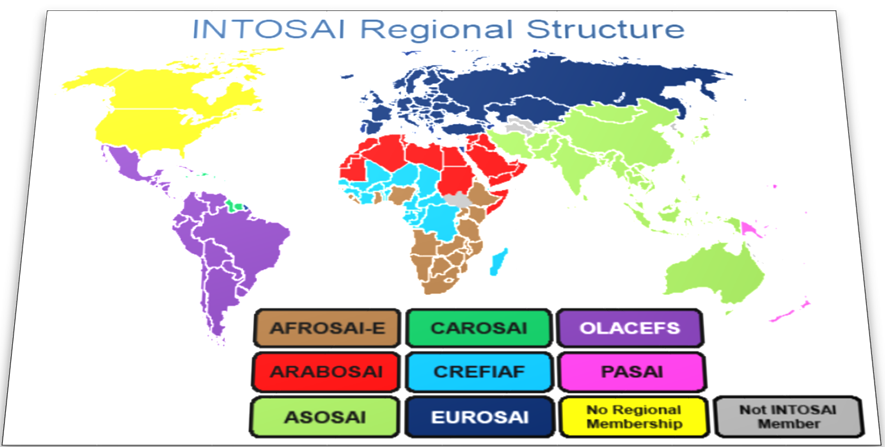
Professional organisations of supreme audit institutions