 Republic of Tunisia
The joint plenary session of the Assembly of the Representatives of the People and the National Council of Regions and Districts resumed its examination of the missions and special missions in the draft State budget for 2026, in the presence of Dean Ibrahim Bouderbala, President of the Assembly of the Representatives of the People, Mr Imed Derbali, President of the National Council of Regions and Districts, and members of both councils.
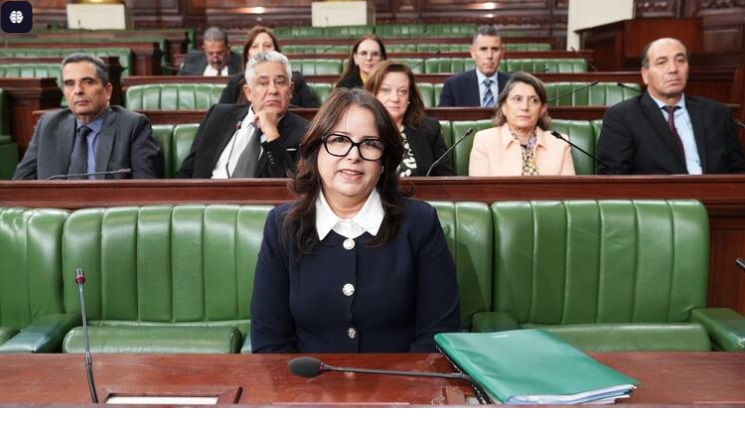
The plenary session held on the evening of Wednesday 19 November 2025 was devoted to examining the special mission of the Court of Accounts in the draft State budget for 2026, in the presence of Ms Fadhila Gargouri, Vice-President of the Court of Accounts, and her accompanying delegation.
The President of the Assembly of the Representatives of the People, Dean Ibrahim Bouderbala, delivered an opening address in which he considered financial justice to have a vital role in combating administrative and financial corruption. He explained that the Court of Accounts performs major tasks within the responsibilities entrusted to it, particularly oversight of sound management of public funds through the preparation of audit reports and examination of accounts. The Court of Accounts has both judicial jurisdiction and audit powers. It also contributes to evaluating public policies and programmes and to formulating precise technical recommendations to remedy failings and lay the foundations for reform.
The President of the Assembly of the Representatives of the People stressed that the Court of Accounts’ oversight should extend beyond accounting and procedural matters to an assessment of the quality of management, use and allocation of public resources. He added that this assessment can improve management methods and practices and free up initiative so as to ensure the highest levels of efficiency and performance.
With regard to reform, Dean Ibrahim Bouderbala also said that State institutions should adopt the Court of Accounts’ recommendations and draw on them when preparing the various reform programmes, to address identified failings, improve and rationalise management methods, and achieve the expected performance objectives.
The Assembly of the Representatives of the People’s General Legislation Committee and the National Council of Regions and Districts’ Committee on Internal Rules, Immunity and Legal Affairs then presented their joint report on the Court of Accounts’ special mission relating to the draft State budget for 2026.
The general debate was then opened. Its first part, devoted to contributions by members of the National Council of Regions and Districts, was chaired by that Council’s President, Mr Imed Derbali. Its second part, devoted to contributions by members of the Assembly of the Representatives of the People, was chaired by that Assembly’s Vice-President, Mr Anouar Marzougui.
The debate addressed the following subjects:
– The importance of the audit reports published by the Court and the significant data they contain on the management of public funds.
– The lack of binding and decision-making force of Court of Accounts reports, which undermines their usefulness and effectiveness and leads to repeated offences and abuses.
– Slowness and delays in preparing and publishing Court of Accounts reports for the general public.
– Questions about the fate of the Court’s audit reports concerning a number of associations and parties.
– A request to review the geographic distribution of the Court of Accounts’ regional chambers in line with citizens’ needs and equality among all regions.
– The insufficient number of judges and the need for the required recruitment; a call to consider radical solutions to the issue of rent for the Court of Accounts’ premises in order to rationalise expenditure.
– The view that electoral sanctions are unfair and a call to review them in proportion to the nature and extent of offences committed.
In response to members’ contributions, Ms Fadhila Gargouri, Vice-President of the Court of Accounts, said that the Court is a reference institution for ensuring the sound use of public funds and combating corruption, which places it in full alignment with State public policies. She said the integrity of the Court’s judges and all its members could not be questioned, and that the quality of the Court’s work was the best proof of this. She affirmed the determination of all its members to remain firm in applying the law through all available legal mechanisms.
Ms Fadhila Gargouri explained that the Court’s reports contain important economic and financial indicators, including debt and inflation rates, the budget deficit and State resources. She said these reports are prepared in accordance with applicable international standards and within deadlines based on the “financial year + 2” rule, before being published both in full and in a simplified version that makes their contents easier to understand.
The Vice-President stressed that the Court is subject to prior control through the prior approval of the public expenditure controller, and to subsequent control by a committee comprising two members appointed by the Financial Judiciary Council, in addition to internal audit designed to ensure governance of the Court’s work.
She considered the Court’s budget an investment in stronger oversight of sound management of public funds across sectors such as transport, health, social affairs and education, rather than a burden on the State. That oversight aims to detect errors and abuses which may in some cases constitute criminal offences.
Ms Fadhila Gargouri explained that the distinction between the chamber of accounts and the Court of Accounts lies in the breadth of their respective fields of intervention. One of the Court’s roles is to detect cases of corruption preventively through the failings it identifies in carrying out its duties.
She highlighted the Court’s discovery, through its investigations, that many associations had received substantial funds from foreign entities. In the absence of a comprehensive information system enabling the State to determine the volume of this financing, a legal framework should be established to enable the State to monitor and oversee the activities of associations and the various components of civil society.
The Vice-President also said that the Court had initiated several reforms, including strengthening its members’ training through distance learning on a digital platform, and had concluded an agreement with the Digital University to develop that system and make it available to public bodies such as ministries.
Ms Fadhila Gargouri stressed that oversight is not an end in itself but an instrument serving transparency and accountability to safeguard public funds, with the overriding objective of building public bodies founded on the principles of good governance.
At the close of her remarks, she welcomed the quality of the dialogue with the legislature, affirming that all proposals and opinions could help develop the Court of Accounts’ work and make its performance more effective.